what causes clouds to reflect a portion of sunlight back into space
How much our world will warm this century depends on the actions we have in coming decades. In order to proceed global temperature ascent below ane.v°C and avoid unsafe levels of warming, governments need to know how much carbon they can emit, and over what timeframe.
But current climate models don't agree on where that threshold lies. In new inquiry, we discovered one of the reasons why there is such a large range of estimates for how much carbon can exist safely emitted: the uncertain behaviour of clouds. In some climate models, clouds strongly dilate warming. In others, they have a neutral effect or even dampen warming slightly. So why are clouds likely to play such a pivotal part in deciding our fate?
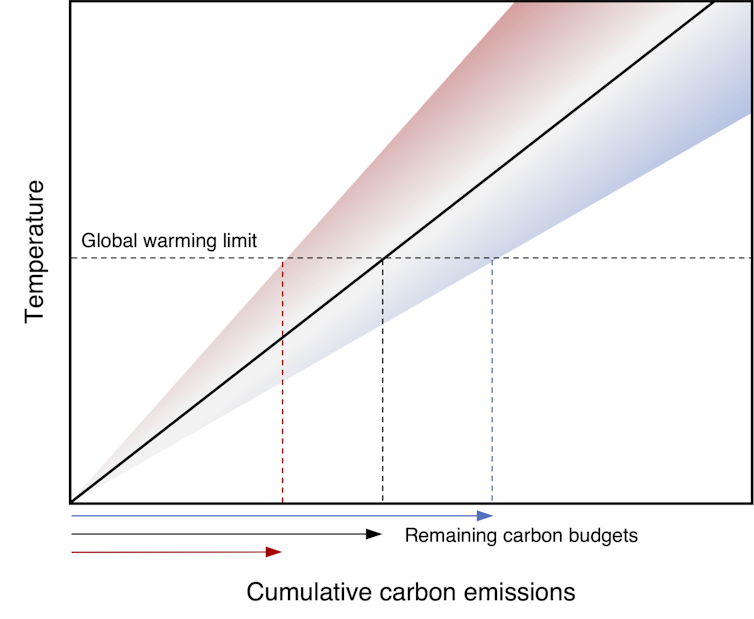
Projections by climate models typically reveal global temperatures rising almost in tandem with the total amount of carbon emitted over fourth dimension. This is represented by the black line in the graph beneath. To avoid exceeding a certain level of warming, the world needs to limit how much carbon is emitted so that it remains inside a sure carbon budget. In climate models where clouds dilate warming, this carbon budget is smaller (red dashed line and arrow). Where clouds accept a nearly neutral or damping outcome, the carbon upkeep is larger (blue dashed line and arrow).
Remaining carbon budgets in climate model projections
Why are clouds then important?
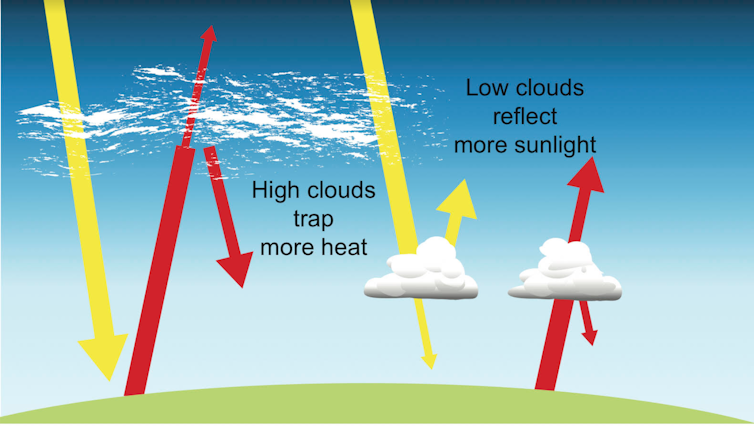
Clouds tin can act like a parasol, cooling the Earth past reflecting sunlight away from the planet's surface and back into space. But they can besides act like an insulating blanket, warming the Earth by preventing some of the estrus in our atmosphere from escaping into space as infrared radiations. This "blanket" outcome is especially noticeable during the winter, when cloudy nights are typically much warmer than cloud-free ones.
Which of these two effects dominates – parasol or blanket – depends on the altitude and thickness of the clouds. As a general dominion, the higher a cloud is, the more effective it is at preventing rut from escaping into space. The thicker a deject is, the meliorate it is at reflecting sunlight abroad from Earth'south surface.
High, thin clouds let sunlight through while effectively preventing heat from escaping to space every bit infrared radiation, providing a net warming upshot. Low, thick clouds strongly reverberate sunlight, while having little impact on infrared radiations escaping to space, creating a cyberspace cooling outcome.
As the atmosphere contains far more low, thick clouds than high, thin clouds, the parasol effect dominates and our planet would be much hotter if clouds did non exist.
The clouds are changing
Global warming is expected to cause changes in the amount of cloud cover, and the height and thickness of these clouds in the hereafter, shifting the balance between the parasol and blanket effects of clouds. The knock-on effect this volition have on temperature is known as cloud feedback. Climatic change projections cannot ignore cloud feedback, as even relatively small changes in cloud backdrop can have significant implications for global temperature.
To predict how clouds will change in the future, our inquiry combines evidence from observations and climate models with theoretical understanding of deject physics. Taken together, this tells us that clouds are more than likely to dilate global warming than they are to dampen it for 2 reasons.
First, the embrace of low clouds is expected to decrease in the tropics as global temperatures ascent, reducing their parasol consequence. Second, it is well understood that high clouds will move into higher regions of the atmosphere as information technology warms, making them more effective blankets. These warming furnishings may exist mitigated slightly by an increase in the thickness of clouds at high latitudes but, particularly over the Southern Ocean effectually Antarctica, but this will not cancel out the overall warming issue.
While we do know that clouds will probable dilate global warming, there is still a great bargain of uncertainty about how strong this effect volition be. Hither climate models are of little help, every bit they can but simulate the bulk properties of the temper over scales of tens of kilometres and several hours. Tiny cloud aerosol form and evaporate in minutes. Models miss these pocket-size-scale details, but they're needed for accurate predictions.
Climate models take to resort to simplifications in order to correspond clouds, which introduces fault. Equally unlike models brand different simplifications in their portrayal of cloud processes, they too make unlike predictions of the cloud feedback, which results in a range of global warming projections and differences in our remaining carbon upkeep. For a given future carbon emissions scenario, clouds are the single well-nigh important factor behind the differences in time to come warming predicted between models.
Should we exist worried?
Climate sensitivity, the corporeality of long-term global warming expected if nosotros double the corporeality of carbon in the atmosphere, is currently estimated to lie between 1.5° and iv.5°C. This consequences of this level of warming are already disturbing, but several new climate models currently being developed by earth-leading researchers are projecting warming in backlog of 5°C. These new models also feature an improved representation of deject processes, and then this seems to suggest that global warming could be fifty-fifty worse than we thought.
Baca juga: Only how hot will it get this century? Latest climate models suggest information technology could be worse than nosotros thought
Thankfully, at that place are alternative projections that indicate towards more than moderate warming. The same models with the highest long-term warming too overestimated warming trends that take already been observed. In the meantime, further research efforts are underway to pin downward the role of clouds in climate sensitivity.
It is clear that our planet volition continue to warm as we carry on emitting carbon into the atmosphere. But by how much will remain written in the clouds.
Source: https://theconversation.com/why-clouds-are-the-missing-piece-in-the-climate-change-puzzle-140812
0 Response to "what causes clouds to reflect a portion of sunlight back into space"
Post a Comment