How to Create Accident Vedio Again Using Software
Photogrammetry and Auto Crashes
Amidst photogrammetry'south many useful applications is in the area of auto crashes, specifically the reconstruction of auto crashes after on-site evidence has been removed. The ability of photogrammetry to remake car accident scenes is tremendously important to the police and forensic specialists who investigate the aftermath of these kinds of events. This is because auto crashes tin can effect in meaning bodily injury, property damage, and death. Sometimes, in these situations, the vehicle or vehicles involved in the crash are destroyed and cannot exist accessed.
- Understanding Automobile Crash Physics
- How Does Photogrammetry Utilize to Car Crash Scenes?
- Car Crash Photogrammetry Software
How can investigators piece an blow back together again? The respond is, in part, photogrammetry software, which can process photos of an accident scene, triangulate their points in 3D space, build 3D models of the expanse, and extract key measurements. Photogrammetric models can be used to recreate blow scenes to determine how fast a car was going when information technology crashed and the direction of travel. Law enforcement or other parties, in turn, can use these reconstructions as testify in courtroom.
In this post, nosotros're going to briefly touch on the physics of auto crashes then talk over how PhotoModeler Technologies' photogrammetry program can assist to reconstruct the scenes of these accidents for police and other forensic investigators.
Understanding Car Crash Physics
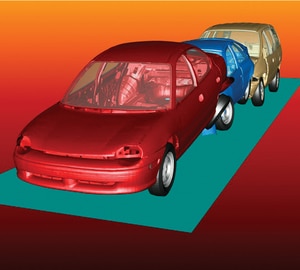
Reconstructing car accidents involves agreement the physics of how they happen. Boiled down to their essentials, car crashes involve a dangerous combination of force and energy. We'll review some of the basic physics for the purpose of this educational resources. We consider three quantities when discussing collisions: force, momentum, and kinetic free energy. When a car strikes an object, the momentum is always preserved. The forces acting on the objects depends on their mass and how they movement (accelerate). Energy is never lost, but full kinetic energy can change (the remaining energy going to sound, oestrus, calorie-free, and fabric deformations). There is also the concept of elastic and inelastic collisions just for the car crash situation, it is a combination of both (this affects how momentum is transferred between objects). A auto tin can hit an immovable object like a edifice, a movable object, similar another car or a bike, or something in between, like a telephone mail. In each case, the two objects human activity differently later on the collision. The important post-collision characteristics here being the speeds and amounts of deformation after the standoff.
We know from personal observation (and from many automobile crashes in the movies!), that a car hitting a big building might exercise a minor corporeality of impairment to the building (a cleft or small-scale dent), but the car volition convert a lot of the kinetic energy into other energy such equally noise and deformation. The large mass of the building (and the earth it is attached also) will mean information technology does not noticeably motion. At the other end of the scale, a car hitting a bicycle or pedestrian, won't take much harm itself but will impart a lot of energy (and damage) to the other object.
If you know the characteristics (mass, friction, etc.) of both objects (one is a motorcar, and the other is a car, building, pole, bike, or person) you lot can determine things such equally the speed at impact. If you lot know the speed, you can determine if the driver was illegally over the speed limit (and hence at mistake). Yous can also make up one's mind directions of travel to confirm bystanders or driver accounts. This data helps decide fault for insurance claims and court cases. It is good for a example when the individuals' exact accounts hold with the physics!
How Does Photogrammetry Apply to Car Crash Scenes?
Photogrammetry software is of import in car crashes because, sometimes, the measurement and models produced by photogrammetric means are the best or merely testify for after litigation in court. Those who work in photogrammetry, or who are long-time readers of the PhotoModeler Technologies weblog, already know that photogrammetry takes measurements from photos – but exactly what is needed to prove causation in a auto blow reconstruction?
For this, the photogrammetry algorithms of a programme such as PhotoModeler need the photos to capture situational elements such as the angle of the crash, possible skid marks on the road, any and all property impairment, the angles at which that property was struck, and, of course, the corporeality of beat out damage in the vehicles themselves.
Overall, photogrammetry gives users the measurements of key aspects of the scene or cars from photos of those objects. From the measurements, investigators use other software or spreadsheets to compute the physics of the situation. They tin can compute the speed of the vehicles past converting car crush measurements into delta-5 (change in velocity) or by measuring sideslip and yaw marks to estimate speed, or to map the scene and all its parts (the route, traffic signals, and light, the marks left by the cars, where the cars concluded up, etc.). The photogrammetric map is useful evidence in court.
It is as well worth mentioning that photos taken for the express purpose of photogrammetry should be taken past someone well-versed in photogrammetry itself. One must know the best camera positions and angles to use, and the correct "targets" to photograph for the photogrammetry software.
The application of measuring an accident scene by the law is one central application. They would use both photographs at ground level as well as photographs from drones. In that location is the power to apply photographs taken past non-experts too – such every bit photographs taken by bystanders, insurance adjusters, or even past security cameras. These secondary photographs, combined with other scene data, can often produce key pieces of bear witness for some cases.
Some other salient point must be considered here: the difference between law and forensic investigators following a automobile crash. The 2 have distinct jobs. Police document prove and make sure none of it gets destroyed. In one case this is done, constabulary must open upwardly roads once more to the public. Meanwhile, forensic investigators must exist able to reconstruct the scene of the crash later the fact, and sometimes with less than perfect information (such as the bystander or security camera images mentioned in a higher place). The police can be involved with this blow scene reconstruction if the crash constituted a fierce crime, and especially if there are fatalities.
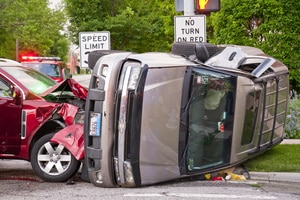
In the finish, nevertheless, by ensuring they acquire sufficient overlapping photos of all the relevant parts of the scene, investigators allow photogrammetric programs to point-lucifer and triangulate the points in the photos and produce a scaled 2d or 3D model of the accident location. With all the model's objects in their correct places and the angles geometrically correct, the forensic investigators can only sit down at a computer and view the scene of a car crash from any bending they choose. This data is used to testify cause and to nowadays cases in courtroom.
Automobile Crash Photogrammetry Software
The incredible usefulness of photogrammetry software in car accident reconstruction is what makes our PhotoModeler production so useful to police force, criminal offence scene investigators, and engineers. PhotoModeler Technologies is proud of its longstanding relationship of 25 years with police force enforcement and the engineering community, and we hope to continue that association indefinitely with our photogrammetry engineering.
To learn more most the PhotoModeler software, contact our corporate part at sales@photomodeler.com .
Source: https://www.photomodeler.com/photogrammetry-and-car-crashes/
0 Response to "How to Create Accident Vedio Again Using Software"
Post a Comment